|
HOME | GREEK LANGUAGE | LIBRARIES | BLOG | HELP | SEARCH | FREEWARE | BOOKSTORE |
|
|
|
|
|
 F. B. Tarbell, A History of Ancient Greek Art

|
The kingdom of Pergamum in western Asia Minor was one of the smaller states formed out of Alexander's dominions. The city of Pergamum became a center of Greek learning second only to Alexandria in importance. Moreover, under Attalus I. (241-197 B.C.) and Eumenes II. (197-159 B.C.) it developed an independent and powerful school of sculpture, of whose productions we fortunately possess numerous examples.
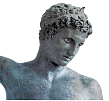
The most famous of these is the Dying Gaul or Galatian, once erroneously called the Dying Gladiator. Hordes of Gauls had invaded Asia Minor as early as 278 B.C., and, making their headquarters in the interior, in the district afterwards known from them as Galatia, had become the terror and the scourge of the whole region. Attalus I. early in his reign gained an important victory over these fierce tribes, and this victory was commemorated by extensive groups of sculpture both at Pergamum and at Athens.
The figure of the Dying Gaul belongs to this series. The statue was in the possession of Cardinal Ludovisi as early as 1633, along with a group closely allied in style, representing a Gaul and his wife, but nothing is certainly known as to the time and place of its discovery.
Next Chapter:
The Rhodes school of sculpture 
Back to the table of Contents * More online Greek Resources

|
|
Reference address : https://www.ellopos.net/elpenor/greek-texts/ancient-greece/history-of-ancient-greek-art-69.asp